
Swift Casino on a handset — the lobby, the cashier, ninety-seven streamed tables, plus every Daily Pick, all reachable through Safari or Chrome with nothing at all to install.
Responsive delivery across iPhone and Android, with a home-screen shortcut giving one-tap entry. No application exists here, and two independent desks confirm it — which for once is a security feature rather than a compromise, because with no legitimate installer, any file circulating under this brand's name is definitionally something else. Reach a library counted between 1,500 and 5,641 depending on which page you open, drawn from roughly fifty studios: NetEnt, Play'n GO, Pragmatic Play, Games Global, Big Time Gaming, Yggdrasil, Betsoft, ELK Studios, IGT, Quickspin, Red Tiger, Relax Gaming, Thunderkick, Playtech and more.
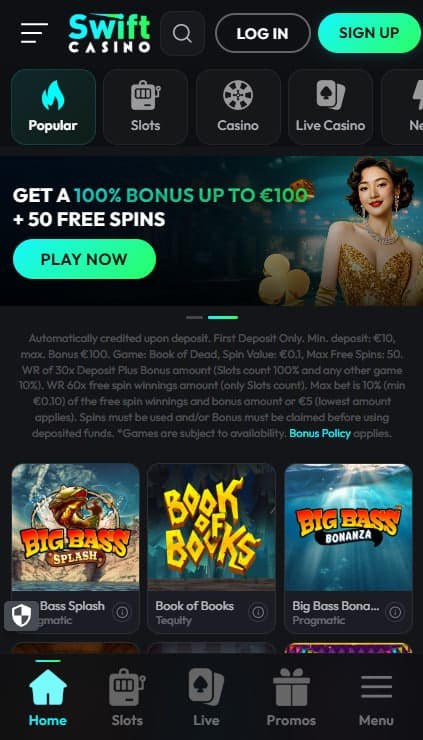
Mobile delivery at Swift Casino is the simplest story in this whole audit, and the surrounding coverage still manages to confuse it. Two independent desks agree there is no application: one states plainly that no such download exists and that the responsive site serves Android and iOS instead, while the other notes players open the lobby in a compatible browser with nothing to install. Both call the browser build solid. That should be the end of it.
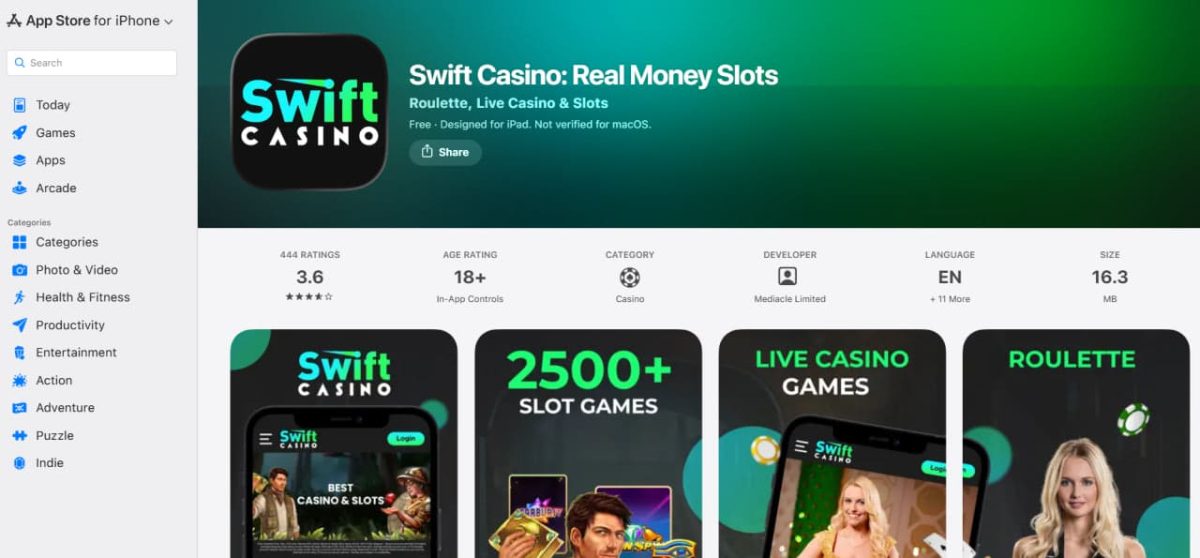
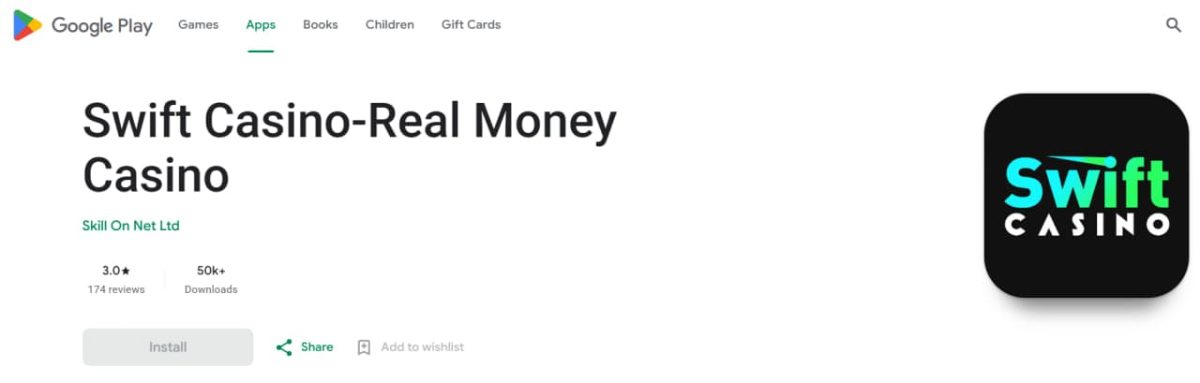
It is not, because two artefacts pull the other way. A specification field on one page marks the mobile app as available, flatly contradicting its own author's prose a few hundred words later. Separately, a marketing microsite claims a dedicated iOS release aimed at Canadians. Neither substantiates anything, no marketplace listing exists, and neither Apple nor Google carries this category into Canada anyway. Our reading: the browser version is the entire product, that data field is stale metadata, and the iOS claim is invention.
Coverage below walks through the practical questions a Canadian arrives with. How to reach the lobby, why the missing download matters less than it sounds, which parts survive a shrunken viewport, how the cashier and document uploads behave through a handset camera, what the desktop build does that a phone cannot, and one warning about installers circulating under a name that has no legitimate installer.
| Access path | How it behaves | Who it suits |
|---|---|---|
| 🌐 Browser session | Open Safari, Chrome or any modern engine, load the domain, play. Nothing installs, and the lobby renders responsively across smartphones and tablets | Everyone, effectively — this is the product rather than a fallback |
| 🏠 Home-screen shortcut | Add the site to your grid through the share menu. One tap, no install prompt, no permission toggles anywhere | Regular players wanting single-tap entry without a download that does not exist |
Notice what is missing from that table. No sideload, no package served from the operator's own pages, no unknown-sources permission — none of the machinery that dominates the Curaçao-permitted competition. For once the absence of an app is a security feature rather than a compromise: no genuine installer exists, so anything circulating under this brand's name is definitionally something else.
Three reasons explain the gap, and only one is about this operator.
Neither storefront handles this category here, which removes the only distribution channel a compiled build would want. Publishing an installer outside a store invites repackaging attacks, where third-party mirrors substitute a tampered file for the genuine one. And the games themselves are identical either way — NetEnt, Play'n GO, Pragmatic Play, Evolution and the rest compile once per title and serve that artefact wherever their catalogue is licensed. A wrapper changes no spin outcome, no return figure, no table limit.
What a native application would actually give you is a shell: an icon in the task switcher, hidden browser furniture, push notifications. That is a polish question, not a capability one. Anyone arriving from a provincially registered lobby with its slick compiled software will notice the difference; anyone who simply wants a reel spinning on a bus will not.
One reviewer frames it accurately when he observes that most Canadian-facing casinos skip applications entirely, so this brand is not an outlier. Where he is less generous is the desktop comparison: he describes the homepage as a bit much at first, blaming heavy animations, while granting that navigation underneath is user-friendly once you adjust. Those animations are the one thing a phone genuinely improves — the mobile build strips them.
Behaviour afterwards sits close to an application without any of the ceremony. Safari holds your session cookie, routes streamed-table audio properly, and hands the camera to the document uploader when verification calls for it. The visible difference: an address bar stays on screen, costing perhaps forty pixels of a display you would rather spend on reels. Given that no alternative exists, that is not much of a trade.
Should your browser surface "Install" instead of the plain wording, choosing it wraps everything through Android's own packaging framework — a dedicated task-switcher card, separate storage, and a standalone window that hides browser furniture. Nothing installs outside Chrome's sandbox, so the unknown-sources toggle never enters the picture. That route gets you closer to native than Safari manages, and it costs nothing.
Less than either side implies. Reel outcomes, table limits, payment rails, support access — identical. Three things move.
Animation load is first, and it favours the phone. Desktop arrival carries heavy motion that one reviewer found overwhelming on arrival; the handset build drops most of it, which makes the small screen the calmer of the two experiences. That is an unusual inversion and worth knowing.
Data and battery come second. Streamed rooms push video and behave accordingly: an hour at a live blackjack table costs about what an equivalent span of streamed television does, adjusted for picture quality. Reels are trivial beside that. Nobody publishes figures and we will not manufacture any, so anyone on a metered plan should treat those tables as the expensive habit and budget accordingly.
Third, and this is the one that irritates: nothing about a handset accelerates a payout. Requests raised from a phone enter the same holding stage — one to three days — and meet the same cap of €5,000 a transaction and €10,000 a month. Convenience at the front door changes nothing at the back.
Funding takes four taps: open the payment area, select a route, enter an amount, confirm. Ten dollars opens an account; four thousand is the single-transaction maximum. No source records friction at this stage, from any device.
Document checks are where a handset genuinely outperforms a laptop, and we recommend that route for exactly that reason. Your identification alongside recent address evidence covers the standard ask, and agents reportedly point Canadians toward a driving licence as the quickest format. Both artefacts capture faster on the device already in your hand than they scan anywhere else. Quoted turnaround runs to twelve hours, sometimes forty-eight where something further is needed.
Two warnings from the dispute file transfer directly to camera work. One player spent a week uploading files, every one refused, receiving automated replies hours apart. Another sent ten documents at once to simplify matters and remained unverified three days later. Photograph everything whole — four corners inside the frame, flat even light, no cropping — because a rejected capture costs a day and the record shows rejections stacking.
Offers reach a handset unchanged, and none is exclusive to it:
One typing warning for small keyboards. The code must be entered manually at registration and again on the qualifying deposit, and a mistyped string simply means no bonus. Copy it rather than trusting thumbs.
Handset delivery is the least contentious part of this brand and among its better features. Everything works. Nothing is missing relative to a desktop session, and the animation-heavy homepage that one reviewer criticised barely survives the transition — which is an improvement. Document capture is faster from a phone than anywhere else. Demo play covers nearly the whole reel catalogue.
Where the browser-only approach costs you is polish rather than capability, and anyone measuring this against a registered provincial lobby's compiled build will feel the gap in the shell rather than the games. Real drawbacks live elsewhere in this review: the payout ceiling, the members-only chat, and a document process that several players describe stacking rejections. None of those improves because you switched devices.
No. Both independent desks say so directly: nothing is published, and the site itself covers both platforms in any modern browser. One classification field lists software as available, contradicting its own author a few lines away, while a microsite claims an iOS build. Neither survives scrutiny, and no storefront handles gambling here regardless.
None exists from the operator, which makes this simple: anything served elsewhere under that name is something different wearing it. Tampered files aimed at credential theft persist across offshore gambling generally, and without a legitimate release there is nothing to compare a suspect file against. Use the browser and the question disappears.
Yes. Reels, streamed tables and the specialty categories all render on a handset exactly as they do on a monitor, because each studio compiles once in HTML5 and distributes that lone artefact to whoever holds a licence for it. Demo rounds work too. Live rooms are the one exception to free play, for the obvious reason that a person is dealing.
They can, and we recommend it. Photographing them beats scanning, and the device is already in your hand, and support reportedly favours a clear driving-licence shot. Frame the whole page, corners included, in even light. Filed cases record one player having documents refused across a full week and another still unverified after submitting ten at once — anything ambiguous costs you time.
Arguably yes, and for one specific reason. Somebody reviewing it found the full-size front page overpowering on arrival, blaming its animation, while rating the navigation beneath it user-friendly. That motion largely disappears on a handset, leaving the cleaner of the two front doors. Beneath the surface both builds behave identically.
Nobody publishes a number and we will not invent one. Video is video: sixty minutes at a dealer table costs roughly what the same amount of streamed TV would, scaled by resolution. Reels stay negligible next to that. On a metered Canadian plan, treat the live floor as the costly category and the reels as free.
Not by a minute. Requests raised on a handset join the same queue as any other — 24 to 72 hours pending — after which wallets land inside a day and cards take two to seven, with nothing processing at weekends. The ceiling of €5,000 per transaction and €10,000 monthly applies identically. Device choice affects nothing downstream.
Only after logging in, if at all. One desk lists email as the sole channel and marks the missing chat as a drawback; another records chat unavailable in its data table while describing it as continuous for members in prose, resolving the conflict by noting it opens to registered accounts only. Players describe it functioning as a delayed message queue. Device makes no difference to any of that.
It does, and it takes under a minute. You will need given name, surname, date of birth, gender and an email address, followed by street address, city, country and province — more fields than most rivals ask, all of it typed on a small keyboard. Collecting residential details up front actually helps you, since the identity check has something to verify against before you deposit rather than after you win.
Apple Pay, comfortably. It is documented as the quickest payout rail at nought to one day, funds from C$10, and needs no card details typed on a phone. Paysafecard is logged as instant on the way out but requires a voucher. Domestic transfer works from a handset yet takes three to five days coming back, which makes it the wrong pick regardless of device.